SUMMARY
Today’s briefing highlights a dynamic threat environment shaped by AI weaponization, zero-day exploitation, escalating ransomware activity, and geopolitical cyber campaigns. Intelligence from multiple high-confidence sources indicates a surge in targeted operations against critical infrastructure, education systems, and software supply chains. Meanwhile, recent vulnerabilities in widely used platforms, such as Windows and WordPress, are being actively exploited with increasing sophistication.
CISOs must prepare their organizations to counter AI-driven threats while accelerating secure-by-design transformations and re-evaluating third-party dependencies. Below is a comprehensive breakdown of key developments and recommended responses.
THREAT LANDSCAPE SNAPSHOT
1. AI-Driven Threats Escalating
- Multiple indicators suggest a shift from passive AI experimentation to operational AI use in offensive cyber operations. Deepfake spear-phishing, prompt injection exploits, and model hijacking have been documented at increasing rates.
- Recent red team evaluations of open-source models (e.g., DeepSeek R1) showed a 100 percent success rate in bypassing guardrails via prompt injection.
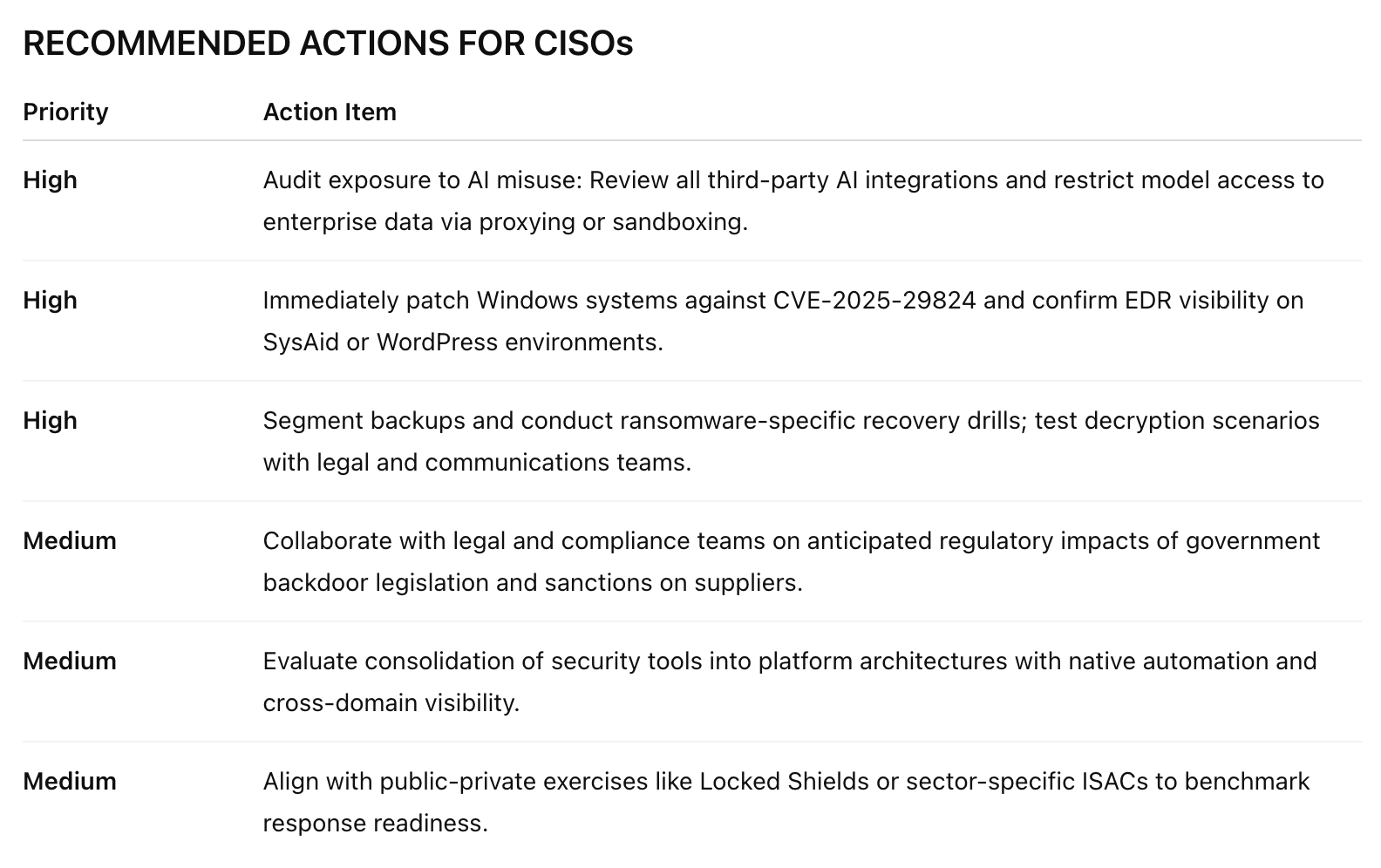
- Enterprise environments must now account for both AI for security and security for AI. This includes defending against model abuse, API exploitation, and uncontrolled agent execution.
2. Zero-Day and Vulnerability Exploitation
- Microsoft disclosed CVE-2025-29824, a zero-day in Windows logging exploited by Play ransomware actors against U.S. targets.
- SysAid patched four critical pre-auth RCE flaws affecting its on-premise ITSM platform.
- OttoKit WordPress plugin vulnerability enabled unauthorized privilege escalation, allowing attackers to create admin accounts.
Implications: Organizations relying on legacy Windows or unmonitored CMS extensions are at immediate risk. Exploit timelines are compressing, sometimes from initial discovery to full-scale weaponization in under 24 hours.
3. Ransomware and Data Extortion Trends
- A second ransomware group has been confirmed exploiting the same Windows flaw mentioned above.
- Threat actors have escalated from centralized extortion to targeting individual U.S. school districts, using stolen data from PowerSchool breaches.
- Masimo, a medical device manufacturer, reported cyber-induced production delays, highlighting ransomware’s crossover impact on operational technology.
Observed TTPs:
- Data theft prior to encryption
- Contactless extortion via dark web leaks
- Use of AI for personalized victim profiling
4. State-Sponsored Activity and Cyber Diplomacy
- Google attributed new malware campaigns to a Russia-based group, leveraging novel TTPs likely aligned with national cyber strategy.
- The UK warns of elevated AI-related cyber threats targeting British institutions as AI adoption scales.
- 41 nations, including NATO members, initiated Locked Shields 2025, a multinational red-teaming drill simulating full-spectrum digital warfare.
- U.S. lawmakers voiced opposition to potential backdoors in Apple devices, warning of global ripple effects on personal security and criminal exploitability.
5. Regulatory and Legal Milestones
- NSO Group has been ordered to pay 167 million dollars in damages linked to WhatsApp spyware deployment.
- U.S. sanctions were placed on Myanmar militia actors tied to cyber fraud infrastructure targeting international victims.
6. Market and Industry Movements
- CrowdStrike is reducing workforce by 5 percent while reaffirming growth guidance, signaling continued market pressure to optimize cost while maintaining performance.
- Ox Security raised 60 million dollars to combat application security alert fatigue, evidence of increasing VC confidence in AppSec automation tools.
- Cisco unveiled a quantum computing strategy leveraging interconnected small-scale machines, raising long-term implications for cryptographic resilience.
STRATEGIC INSIGHTS
1. Tactical AI Response Is No Longer Sufficient
Security teams must establish policy frameworks for AI deployment that address model provenance, agent authorization, and data governance. Network-level controls and behavioral analytics must evolve to detect AI agent anomalies before actions occur.
2. Shift from Reactive to Proactive Vulnerability Management
Zero-day exploits are compressing remediation windows. CISOs should assess exposure to recently patched vulnerabilities with emphasis on Windows logging services, SysAid deployments, and web CMS plug-ins. Integration with real-time threat intelligence is critical.
3. Ransomware Must Be Treated as a Business Continuity Crisis
Backup integrity, tabletop exercises, and communications planning should now be part of core business continuity frameworks. Additionally, segmentation of OT and IT networks is mandatory to avoid spillover into physical operations.
4. International Policy Is Reshaping Enterprise Risk
Geopolitical developments, particularly around state-directed cyber activity, will require risk managers to factor in political attribution, state-level deterrents, and public-private collaboration. Supply chain exposures to sanctioned or unstable regions must be mapped.
5. Alert Fatigue Is Becoming an Enterprise Risk
Excessive alerting continues to hinder security team effectiveness. CISOs should prioritize investments in automation, deduplication, and AI-assisted triage to free human analysts for high-value threat hunting.
CLOSING PERSPECTIVE
The velocity of cyber operations, both defensive and offensive, is accelerating. Traditional perimeter thinking, compliance-based checklists, and fragmented security operations cannot withstand the AI-era onslaught.
Enterprise resilience now depends on a philosophy of unified security architecture, cross-functional coordination, and predictive response readiness. Security leadership must treat AI not as a technology feature, but as a new operational domain requiring governance, visibility, and constraint.